
A Nature-Based Solution to Landslide Risk

For the residents of Achham in Sudurpashchim Province, the annual monsoon season has historically been a time of conflicting emotions. While the rains are essential for agriculture, they bring with them a pervasive nervousness regarding the stability of the slopes. The hills of Turmakhad are prone to soil erosion and landslides, turning the life-giving rain into a threat to homes, livelihoods, and physical safety. The community needed a disaster risk reduction (DRR) solution that could withstand the intense weather patterns of the region without imposing an alien, static structure on an already shifting landscape.
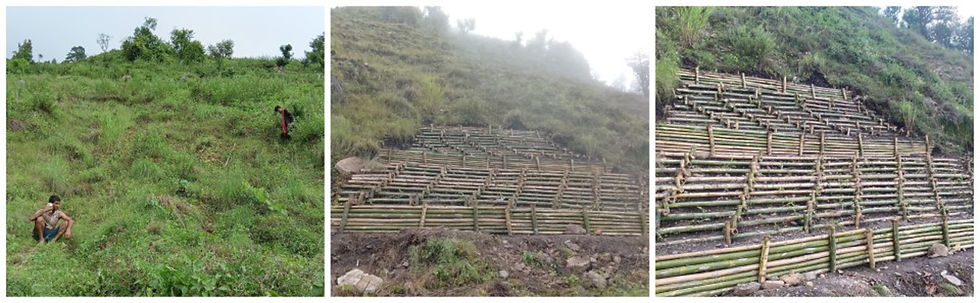
To address this vulnerability, the LACC Project implemented the Khada Chaur Bio-Engineering scheme. Unlike conventional grey infrastructures, this initiative utilized nature-based solutions designed to evolve. The technical approach involved a complex weaving of biological and physical elements directly into the hillside.
The intervention utilized bamboo crib walls and check dams to provide immediate structural support. These were complemented by grass plantations, palisades, and brush layering. This methodology ensures that as the initial constructions eventually weather, the growing biological elements take over. The roots of the native grasses and bamboo bind the soil, creating a subterranean net that holds the earth together more effectively than rigid materials could.
While the technical strategy was vital, the execution relied entirely on community ownership. The true strength of the LACC Project lay in the hands of the people of Kadachaur. The construction process was a community-led endeavour where residents were physically building the wall themselves and provided stewardship, which is necessary for success. This participatory approach ensured that the community was not just a beneficiary of aid, but the active architect of their own resilience.
Five months following the implementation, monitoring visits revealed a remarkable transformation. The landscape has begun to reclaim the man-made structures. The bamboo and native grasses have taken hold, causing the initial construction to slowly disappear behind a veil of greenery.
What began as a visible crib wall is transforming into a natural barrier, a wall of living protection that grows stronger with every rainfall rather than weaker. The contrast between the before state of the landscape and its current condition highlights a significant ecological recovery. The process is slow and steady, but most importantly, it is alive. The Khada Chaur scheme stands as a testament that sustainable DRR is not about conquering nature, but about evolving alongside it.
This story was originally published in the LACC Project Semi-Annual Progress Report FY 2025/26. It has been reproduced on the LACC website with minor editorial edits for readability while preserving the original content and meaning.

Comments