Result Area 1
Climate resilient livelihoods and gender equal and inclusive management and conservation of terrestrial ecosystems with the following outputs:
Output 1.1: Climate-resilient agricultural and agro-forestry practices strengthened to promote food security and income improvement
Output 1.2: Sustainable use of natural resources as energy sources, promoting time efficiency, especially for women
Output 1.3: Communities, with equal participation from all, are able and motivated to manage and conserve land and natural ecosystems
The challenge
Karnali and Sudurpashchim provinces face significant risks from climate change, poverty, and inequality. Communities are highly vulnerable to extreme weather events such as droughts, flash floods, and landslides, which degrade natural resources and threaten subsistence farming. Forest resources, while abundant, often lack sustainable management, with many Community Forest User Groups (CFUGs) operating under outdated plans. Furthermore, high rates of seasonal male migration have led to the “feminization of agriculture,” leaving women with the heavy burden of managing households, farming, and collecting firewood and fodder. These challenges are compounded by geographical remoteness and a lack of local income opportunities, leading to persistent food deficits and permanent emigration.

Our Work
LACC addresses these challenges by applying a landscape approach that recognises the interconnectedness of ecosystems and human activities. We promote climate-smart agriculture and crop diversification, such as integrating traditional mountain grains with high-value off-season vegetables, to enhance food security and income. To mitigate environmental hazards, the project implements nature-based solutions, primarily bioengineering. This approach uses local materials like bamboo and native grasses to stabilize slopes and prevent soil erosion. We also strengthen local institutions by assisting CFUGs and Leasehold Forest User Groups (LFUGs) in renewing their Operational Plans with a focus on sustainable harvesting and biodiversity conservation. Additionally, the installation of Improved Water Mills (IWMs) and Improved Cooking Stoves (ICS) reduces carbon emissions while saving significant time and physical labor for women.
The Change We Aim to See
We are working toward a future where communities enjoy improved food security and robust income generation. Ultimately, we aim for a reality where local communities, driven by the equal participation of all members, are fully capable, motivated, and empowered to sustainably manage and conserve their own land and natural ecosystems.
Examples of Our Activities
Climate-Smart Agriculture Practices
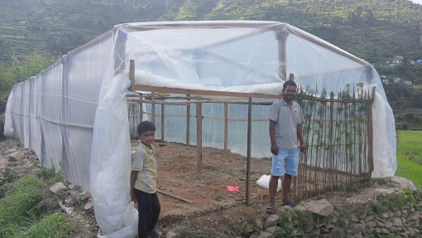
Promotions of Climate Adaptive Technologies and support of greenhouses for off-season vegetables, drip irrigation sets, and integrated pest management kits.
Nature-Based Solutions
Bioengineering schemes using crib walls, palisades, and brush layering for landslide and flood mitigation.
Agroforestry & Nurseries
Establishing multipurpose nurseries and plantations for high-value species like timur and large cardamom.
Renewable Energy
Installation of energy-efficient Improved Water Mills (IWM), Improved Cooking Stoves (ICS) at household and school level.